JBS Reports US$221 Million Net Income in the First Quarter of 2026
13 | 05 | 2026

The program, TOGETHER: People + Forests + Livestock, aims to assist over 3,500 families in the states of the Legal Amazon, starting with Pará, with support also in achieving zero deforestation
13 | 12 | 2023
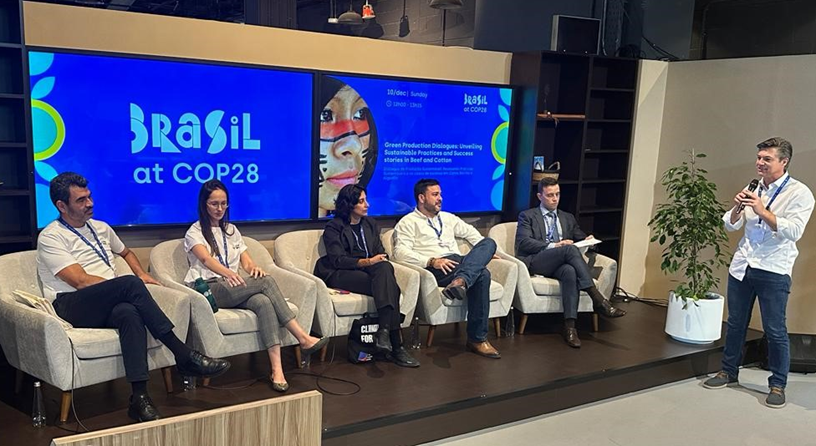
On Sunday (12/10), at COP, the JBS Amazon Fund officially introduced its TOGETHER program: People + Forests + Livestock, an initiative that integrates scalable business models generating value through improved land use and increased productivity, freeing up areas for forest recovery and other productive activities, ensuring traceability and promoting a dignified income for small livestock producers’ families in the Amazon.
The presentation, led by JBS Sustainability Director Liège Correia, took place during the panel “How to Support Small Producers in a Just Transition to Low-Carbon Agriculture in the Amazon,” organized by the Legal Amazon Hub and conducted by Raul Protázio, Deputy Secretary of Environment and Sustainability of Pará. The discussion also included participants such as Leonardo Botelho Ferreira, Head of International Cooperation at BNDES; Valmir Ortega, CEO of Rio Capim Agrossilvipastoril; Mariana Pereira, Program Manager at the Solidarity Foundation; and Petra Tanos, Director of Private Sector Engagement and Strategic Partnerships at the Tropical Forest Alliance (TFA).
Over the next ten years, the JBS Fund aims to allocate R$100 million to TOGETHER, leveraging other funds from public, private, and donation sources, amounting to over R$900 million in investment in the hubs and properties served.
The initial phase of the initiative supports the inclusion of calf and yearling producers in the transition to low-carbon livestock. The initiative aims to more than double the producer’s income, considering the entire property. In intensified areas, profitability can increase up to six times. The proposal also envisions a traced chain from origin with socio-environmental compliance. The idea is to have business hubs that support small producers in pasture reform, access to technologies for productivity improvement through agro-silvopastoral techniques, supplying the market with high-quality, low-carbon animals.
“Today, the structure of livestock in Brazil is a long cycle, and there are many intermediaries for traceability. The small producer ends up selling their breeding animals to buyers, who then pass them on to a breeding producer, who in turn passes them on to a fattening producer until it reaches the industry. So, the idea is to shorten this chain. With more traceability, we have more control and can remove those with irregularities in their process from production,” said Liège Correia.
“It is very common to hear from family farmers phrases like: they brought us here and then turned their backs on us. The fact is that today 90% of rural properties in Pará, and this scenario multiplies throughout the Amazon, are family farmers. They retain 50% of the state’s herd and livestock. The context is very low productivity. Our production average is 60 kilos per hectare/year when the target average should be pursued is 300 kilos per hectare/year. Below that, some say that a property becomes economically unviable,” said Protázio. “This is, therefore, the scenario: low productivity, technology, environmental regularization, land regularization, and little access to credit.”
“This is a problem that should have the producer at its center. They should be at the center of discussions and solutions because it is their behavior that we are trying to change, and they are the ones who can apply solutions to reduce emissions, apply regenerative agriculture, and reduce deforestation, in the case of cattle production in Brazil,” said Petra Tanos from the Tropical Forest Alliance (TFA). “I don’t think they want to destroy nature; they just want to provide a livelihood for their families. Projects that make this happen are the ones that will succeed. We are talking about a huge number of producers, and how can we scale these solutions and tools? For that, it is necessary to have a whole-sector approach. A single company can do a lot, but supply chain actors have to join the discussion,” Tanos said.
Access to credit for family farming was one of the highlights of the presentation by Leonardo Botelho Ferreira, Head of International Cooperation at BNDES. “The Amazon has various types of enterprises, and each of them needs a type of financing. In this sense, BNDES intends to create different products. We have already practically doubled the bank’s resources for projects related to family farming. This represents a leap from R$5.7 billion in the period 2022/2023 to R$11.6 billion in 2023/2024,” he said.
During the occasion, Liège Correa also detailed other initiatives of the JBS Fund to advance in the region. “Our goal is to develop a sustainable economy in the Amazon biome. So, the JBS Fund is based on three pillars: bioeconomy, productive chains, and science and technology. The entity already has some lines of action and has invested R$73 million in the last three years, benefiting more than five thousand families with more than 20 supported projects. Some initiatives are not related to livestock, such as those that work with the pirarucu, açaí, cocoa chains, precisely to promote the development of the biome’s economy,” said the executive.
“Another project supported by the JBS Fund is RestaurAmazônia, which already has 1,500 assisted families today with cocoa and livestock SAF, recovering degraded pastures,” said Correia. The initiative promotes low-carbon agriculture through the implementation of agroforests – with cocoa as the flagship – combined with sustainable livestock and forest conservation in the Paraense Transamazon region. The project provides technical assistance so that family farmers in the region have access to new technologies and best practices, as well as investing in the incubation of business in cooperatives in the region.
According to Liège Correia, JBS now intends to expand this model and add the individual traceability module. “We know that there is this challenge of forest production, but it is very important to consider the people. When we talk about agriculture, family livestock, we have to think about these families in the field. The other part of what we want to bring to livestock in Pará is the individual traceability project, which is very connected to the state government’s strategy,” she said. Last Friday (12/01), the Company announced its adherence to the Sustainable Territories Platform, through which the government of Pará is bringing together efforts to achieve the agreed target of producing 140,000 hectares of regenerative agriculture and livestock in the state by 2025.
Investments in research and technical advancement in the field
During Sunday (12/10), JBS Sustainability Director, Liège Correia, also participated in the panel “Sustainable Production Dialogues: Revealing Sustainable Practices and Success Stories in Beef and Cotton,” where she pointed out that one of the most significant opportunities to advance low-carbon livestock in Brazil is in investing in science and research.
“Brazil has a great opportunity to advance with science to have its own emission data and its own research, thinking about the production conditions here in the country. Because the dynamics of tropical livestock are very different from those of farms in the United States or Europe. And, on this front, we have been working, regarding regenerative agriculture, on an important point, which is pasture. It had never been treated as agriculture; it has always been a very marginal thing, but today, livestock is already considered a third crop, with the integration of crop-livestock-forest. So now, livestock comes as an opportunity to produce more in the same area, without the need to open new pastures, complementing the use of a crop, for example,” she said.
The Company has been investing in significant research areas, such as carbon capture from pastures through well-managed grazing, as well as other initiatives seeking agricultural sustainability, such as the adoption of food additives to reduce enteric methane emissions from animals and the use of biogenic methane as fuel. Correia also points to even more advanced circularity opportunities, such as research on the application of rumen fluid generated by the animal as it grazes into the soil, aiming for regenerative agriculture.
The JBS executive highlighted the need for these productivity-enhancing solutions to effectively reach producers. The Company has been doing this through initiatives such as its Green Offices, which provide free technical assistance to producers throughout Brazil, as well as through initiatives of the JBS Amazon Fund, founded three years ago.
Published by: JBS Brazil