JBS Reports Record Net Sales in the Second Quarter of 2026
10 | 08 | 2026

The JBS Fund for the Amazon launched the first-of-its-kind “FUTURE” Fund – the United Territories Fund for Educational Resources - earlier this month for Interelos Institute. With an initial injection of R$1.6 million and a target raise of R$ 60 million by 2027, it will maintain and fund the expansion of rural education models.
22 | 03 | 2023
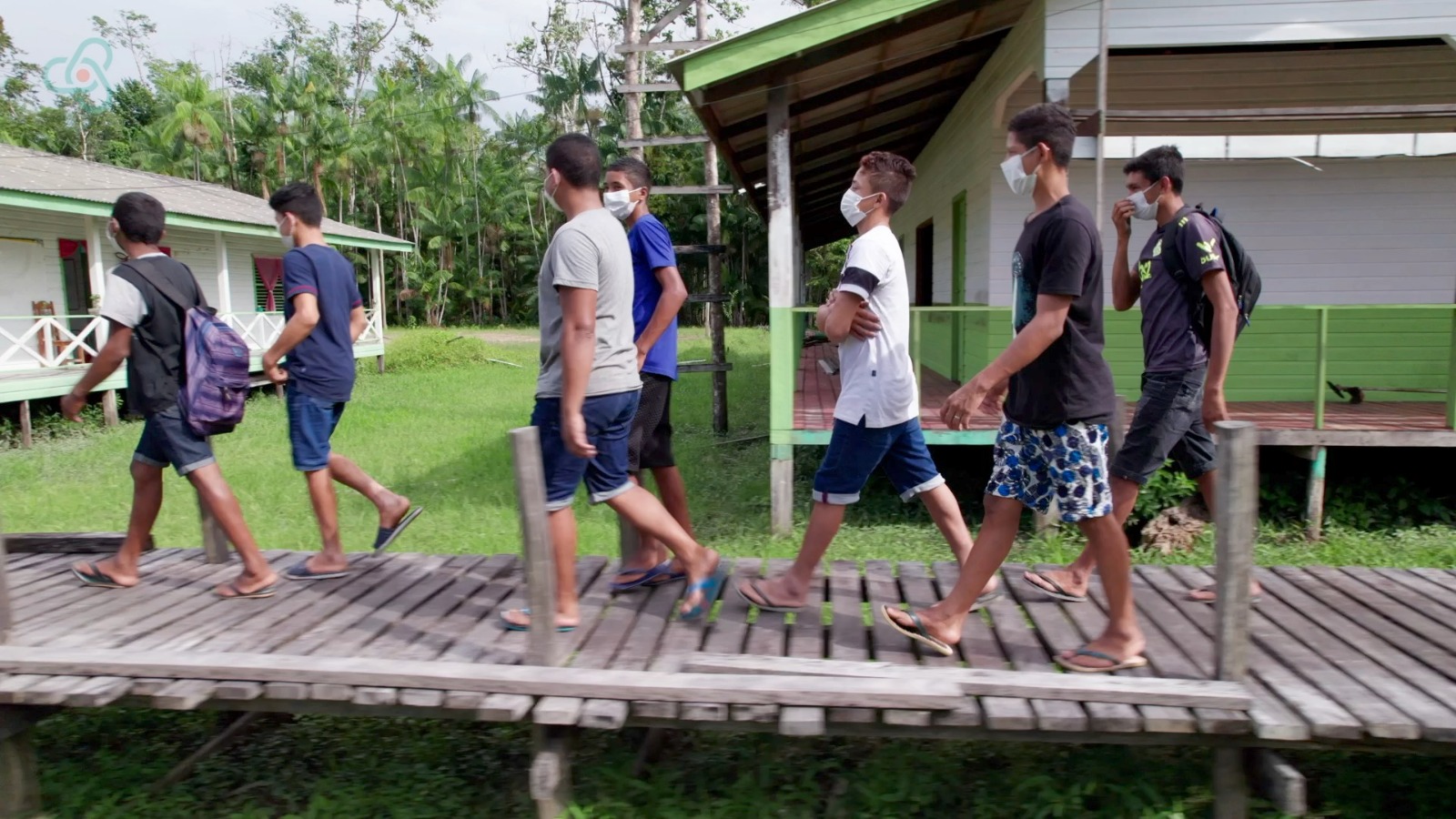
On March 21st, International Forest Day, the Interelos Institute, with the support of the JBS Fund for the Amazon, officially launches FUTURE – the United Territories Fund for Educational Resources. This is the first endowment fund designed to finance Family Farming Schools (EFA) and Rural Family Homes (CFR) in the Amazon. The model integrates education into the production chain by introducing the reality of young people on the land as an element of learning so as to achieve a more continuous and long-lasting character. It can be placed within the context in which Brazil is once again drawing domestic and international attention to the region and in which investments in education and sustainability have once again become a priority.
The initial injection of R$ 1.6 million by the JBS Fund for the Amazon has enabled FUTURE to be structured and will contribute to its upkeep for the next three years.
It is estimated that by 2027 the fund will raise R$ 60 million.
Inspired in a French model, the Family Farming Schools (EFAs) and Rural Family Homes (CFRs) began to take shape in Brazil in the 1980s, and today they are part of the reality of students, teachers and entire families in the less populous regions furthest removed from Brazil’s major centers.
In the Amazon, and in low-density population areas, the long distances make it difficult for students to commute to traditional schools. It is within this context that the EFAs and the CFRs appear as one of the most appropriate teaching models, since they are based on trade-off teaching – a method in which the student spends 15 days at school and 15 days at home, enabling these young people to share what they learn with their families by applying the production techniques acquired from teachers and colleagues. It is a differentiated education that interfaces with environmental education, the rational use of resources, protection of biodiversity and environmental conservation.
The rural education model has proven to be an effective tool for preventing school truancy and, above all, guarantees learning that is aligned with specificities of each communities and with the regional culture. However, the greatest challenge today is financial intermittence, since the on-lending of government resources isn’t always of a continuous nature and enough to maintain the educational structure.
Thus, the new FUTURE endowment fund has arisen to face the challenge of the continuity of these schools, starting with the EFAM – the Macacoari Agro-ecological Family School (already operational) and the EFAB –the Bailique Extractivist Family Farming School (being structured). These two units will be the new fund’s replication and expansion models.
” FUTURE will not only guarantee the cash flow for the schools but will also host projects to assist with quality in managing the teams that will train the students themselves. This will be a fundamental part of the knowledge. We are saying that this biome is important and a fundamental part of this biome are its people, it is they who can make the transformations. The fund is perhaps one of the most in-depth contributions to the process of the preservation, conservation and sustainable expansion of the Amazon biome, ” in the opinion of Aerton Paiva, anthropologist and founder of the InterElos Institute.
The initiative is one of the ramifications of the Inclusive Community Economies Program, one of the first projects supported by the JBS Fund for the Amazon. The partnership began in 2021 and is a joint initiative with the InterElos Institute, Amazonbai, the State University of Amapá (UEAP), the International Education Institute of Brazil (IEB) and the Terroá Institute. For Joanita Maestri Karoleski, president of the organization, the educational challenges in the Amazon include content that is totally divorced from the reality of the local communities, long-distance commuting and truancy on account of work, primarily in high school education. “Many adolescents leave school to help their families with fishing and farming. That is why education must be thought through from the local social dynamic, within the reality of the families. And FUTURE will be able to promote the educational models most suited to the routine of the young people and the local socioeconomic activities. This is the impact that the JBS Fund for the Amazon is expecting”, she states.
How does it work?
FUTURE will be open to institutional fundraising as well as donations from private individuals.
It has been structured like a wealth fund , also known as an endowment or benevolent fund . In Brazil, this is governed by Law 13.800 of January 4th, 2019 that deals with the constitution of wealth funds for the purpose of raising, managing and channeling donations by businesses and private individuals to programs, projects and other purposes of public interest.
“There is nothing more transformative than to imagine that in 10 years’ time the students that graduate from the Family Schools will be equipped as managers, to contribute to improving management across all production chains. We are beginning with fishing and açaí, but the benefits will certainly affect the Brazil nut and cocoa chains, and so on. The potential of the knowledge is unlimited”, concludes Paiva.
Published by: JBS Brazil